Sunday, February 6, 2011


Saturday, February 5, 2011
Kay Sage
Quote
" Sage represents on of the central dilemmas of our age: the tension between humans as both natural beings and as creators of the 'unnatural' the urban"
Female Gazes, Seventy-five women artists
Elizabeth martin and Vivian Meyer
Second story press 1997
" Sage represents on of the central dilemmas of our age: the tension between humans as both natural beings and as creators of the 'unnatural' the urban"
Female Gazes, Seventy-five women artists
Elizabeth martin and Vivian Meyer
Second story press 1997
Thursday, February 3, 2011
Notes on current projects
Statement:
Our role as artists is to create, examine, repurpose, and digest visual elements that surround us. Many attributes that we scrutinize are perhaps unfamiliar or distant to one’s own knowledge. In order for myself to create broader connections with things of the unknown I am creating an intimate visual language for myself to explore, recreate and divulge my naiveté towards matters which perhaps others already understand.
A Quick outline of some thoughts
* Finding my place with in the landscape
* Using the surreal/ imaginary as an access point/ or using the natural as an access point?
*an entry point into the natural landscape literally and Figuratively
*Forming these imaginary Senarios that can ELUDE to an actual
*Using the objects I create as a tool/ to study natural/ as an experiment/ as a control / using the research to formulate qualities that MIMIC nature
evaluating nature by mimicking certain forms.
*To study and create may bring me to a closer UNDERSTANDING
A scientist would do a series of tests/ An artist recreates visual information to heighten understanding/ break down and repurpose images to define it further.
*what is my understanding? By having to work IN the landscape I am being exposed to to things I don't know. Activating the senses, touch, feel, smell
*artifact from the experience.
*Having the experience
*Taking control of nature ( to the un known) and creating nature for myself as the (known) The ability to have control over the landscape or the natural
Fantasy (disambiguation)
From Wikipedia, the free encyclopedia
| | Look up fantasy in Wiktionary, the free dictionary. |
Fantasy is a genre of art, literature, film, television, and music that uses magic and other supernatural forms as a primary element of either plot, theme, or setting.
[edit]
Other uses
Fantasy (psychology), a situation imagined by an individual or group, which does not correspond with reality but expresses certain desires or aims of its creator
Journey:
adventure, airing, beat, campaign, caravan, circuit, constitutional, course, crossing, drive, expedition, exploration, hike, itinerary, jaunt, junket, march, migration, odyssey, outing, passage, patrol, peregrination, pilgrimage, progress, promenade, quest, ramble, range, roaming, round, route, run, safari, sally, saunter, sojourn, stroll, survey, tour, tramp, transit, transmigration, travel, traveling, traverse, trek, trip, vagabondage, vagrancy, venture, visit, voyage, wandering, wayfaring
fansaty:
Atlantis, Utopia, air castle, apparition, appearance, bubble*, chimera, conceiving, creativity, daydream, delusion, envisioning, externalizing, fabrication, fairyland, fancy, fancying, fantasia, figment, flight, flight of imagination, fool's paradise, hallucination, head trip, illusion, imaginativeness, imagining, invention, mind trip, mirage, nightmare, objectifying, originality, rainbow*, reverie, trip, vagary, vision
Notes:
fantasy is imagination unrestricted by reality;
Synonyms: for reality
absoluteness, actuality, authenticity, being, bottom line, brass tacks, certainty, concreteness, corporeality, deed, entity, existence, genuineness, how things are, like it is, materiality, matter, name of the game, nuts and bolts, object, palpability, perceptibility, phenomenon, presence, real world, realism, realness, sensibility, solidity, substance, substantiality, substantive, tangibility, truth, validity, verisimilitude, verity, way of it, what's what
Quick Notes on Surrealism
Surreal
From Wikipedia, the free encyclopedia
Surreal in general means bizarre or dreamlike. It may refer to:
- Anything related to or characteristic of Surrealism, a movement in philosophy and art
Freudian
Freud initiated the psychoanalytic critique of Surrealism with his remark that what interested him most about the Surrealists was not their unconscious but their conscious. His meaning was that the manifestations of and experiments with psychic automatism highlighted by Surrealists as the liberation of the unconscious were highly structured by ego activity, similar to the activities of the dream censorship in dreams, and that therefore it was in principle a mistake to regard Surrealist poems and other art works as direct manifestations of the unconscious, when they were indeed highly shaped and processed by the ego. In this view, the Surrealists may have been producing great works, but they were products of the conscious, not the unconscious mind, and they deceived themselves with regard to what they were doing with the unconscious. In psychoanalysis proper, the unconscious does not just express itself automatically but can only be uncovered through the analysis of resistance and transference in the psychoanalytic process.[citation needed]
Surrealist Manifesto
Breton wrote the manifesto of 1924 that defines the purposes of the group. He included citations of the influences on Surrealism, examples of Surrealist works and discussion of Surrealist automatism. He defined Surrealism as:Dictionary: Surrealism, n. Pure psychic automatism, by which one proposes to express, either verbally, in writing, or by any other manner, the real functioning of thought. Dictation of thought in the absence of all control exercised by reason, outside of all aesthetic and moral preoccupation.
Encyclopedia: Surrealism. Philosophy. Surrealism is based on the belief in the superior reality of certain forms of previously neglected associations, in the omnipotence of dream, in the disinterested play of thought. It tends to ruin once and for all other psychic mechanisms and to substitute itself for them in solving all the principal problems of life.
Tuesday, February 1, 2011
Ana Mendieta


Ana Mendieta (18 November 1948 – 8 September 1985) was a Cuban-American artist famous for her performance art and “earth-body” sculptural, photographic, and video work.
Mendieta was born in Havana, Cuba but moved to the United States at a young age. In 1961, at the age of 13, she and her older sister Raquelin were exiled from Cuba because her family opposed the revolutionary government. They were placed in several institutions and foster care in Iowa through Operation Peter Pan run by Catholic Charities with the collaboration of the US government.
She earned a BA from the University of Iowa in 1969 and subsequently earned an MA in Painting and an MFA in Intermedia. Throughout the course of her career, she created work in Cuba, Mexico, Italy, and the United States of America.
Much of Mendieta’s work may be considered strongly feminist by some; it is in essence autobiographical. One theme in her early performance art was violence against the female body. Later Mendieta focused on a spiritual and physical connection with the land, most particularly in her Silueta pieces, which typically involved carving her imprint into sand or mud, making body prints or painting her outline or silhouette onto a wall. In 1983 she won the Prix de Rome and took up residence in Rome, Italy. During the last 2 years of her life she started creating “objects”, mostly permanent sculptures and drawings, it was her intention to retain the connection with nature via the vibrations of the natural elements she continued to use in the works.
She died on 8 September 1985 in New York from a fall from a 34th floor apartment inGreenwich Village. Eight months earlier Mendieta had married the minimalist sculptorCarl Andre. Andre was tried and acquitted of her murder; during the trial his lawyer described her death as a possible accident or a suicide. In the absence of any witness to her death, other than (possibly) Carl Andre, the exact cause of her death may never be known.
Her estate is managed by the Galerie Lelong in New York City.
Bibliography
- Blocker, Jane. Where Is Ana Mendieta?: Identity, Performativity, and Exile. Duke University Press, May, 1999.
- Cabañas, Kaira M. “Ana Mendieta: ‘Pain of Cuba, body I Am.’” Woman’s Art Journal 20, no. 1 (1999): 12-17.
- Clearwater, Bonnie, ed. Ana Mendieta: A Book of Works. Grassfield Press, November, 1993.
- Heartney, Eleanor. “Rediscovering Ana Mendieta.” Art in America 92, no. 10 (2004): 139-143.
- Jacob, Mary Jane. “Ana Mendieta: The “Silueta” Series, 1973-1980″. Galerie Lelong, 1991.
- Katz, Robert. Naked by the Window: The Fatal Marriage of Carl Andre and Ana Mendieta. Atlantic Monthly Press, 1990.
- Kwon, Miwon. “Bloody Valentines: Afterimages by Ana Mendieta”. In: Catherine de Zegher (ed.),Inside the Visible. The Institute of Contemporary Art, Boston & MIT Press, 1996.
- Moure, Gloria et al. Ana Mendieta. Poligrafa, April 2, 2001.
- Perreault, John and Petra Barreras del Rio. Ana Mendieta: A Retrospective. The New Museum of Contemporary Art, New York, 1987.
- Raine, Anne. “Embodied Geographies: Subjectivity and Materiality in the Work of Ana Mendieta.” In Feminist Approaches to Theory and Methodology: An Interdisciplinary Reader, edited by Sharlene Hesse-Biber, Christina Gilmartin, and Robin Lydenberg, 259-286. New York: Oxford University Press, 1999.
- Rauch, Heidi, and Federico Suro. “Ana Mendieta’s Primal Scream.” Américas 44, no.5 (1992): 44-48.
- Viso, Olga. Ana Mendieta: Earth Body. Hatje Cantz Publishers in collaboration with the Hirshhorn Museum and Sculpture Garden, 2004.
- Viso, Olga. Unseen Mendieta: The Unpublished Works of Ana Mendieta. New York: Prestel, 2008.
- Walker, Joanna, ‘The body is present even if in disguise: tracing the trace in the art work of Nancy Spero and Ana Mendieta’. Tate Papers, Spring 2009. Seehttp://www.tate.org.uk/research/tateresearch/tatepapers/09spring/joanna-walker.shtm
FROM Wikipedia
Pilgrimage to the Magical Relic

As another attempt to connect with the natural world I am creating a special place where one can travel too for reflection, though or even call on the powers that be while amongst the raw earth.
As I carefully attempt to recreate facets of the earth, I am also allowing my wildest fantasies come to life within the this piece of fictional landscape that I create. Allowing myself the arena on which to dream and also explore actual existence thus inherently brings me closer to understanding my place in the landscape.
Closed

Open

Onion pieces cast in wax

Drawings of relic


Behold the Magical rock .......
( in process)


Behold the magical relic
(In process)
(In process)
Copper mesh electroformed, and gold leafed

Cast onion in nu gold


Electroformed rocks
made with foam, dipped in wax

Other samples


Magical Relic
Cast bronze, electroformed , gold leaf( ha), brass
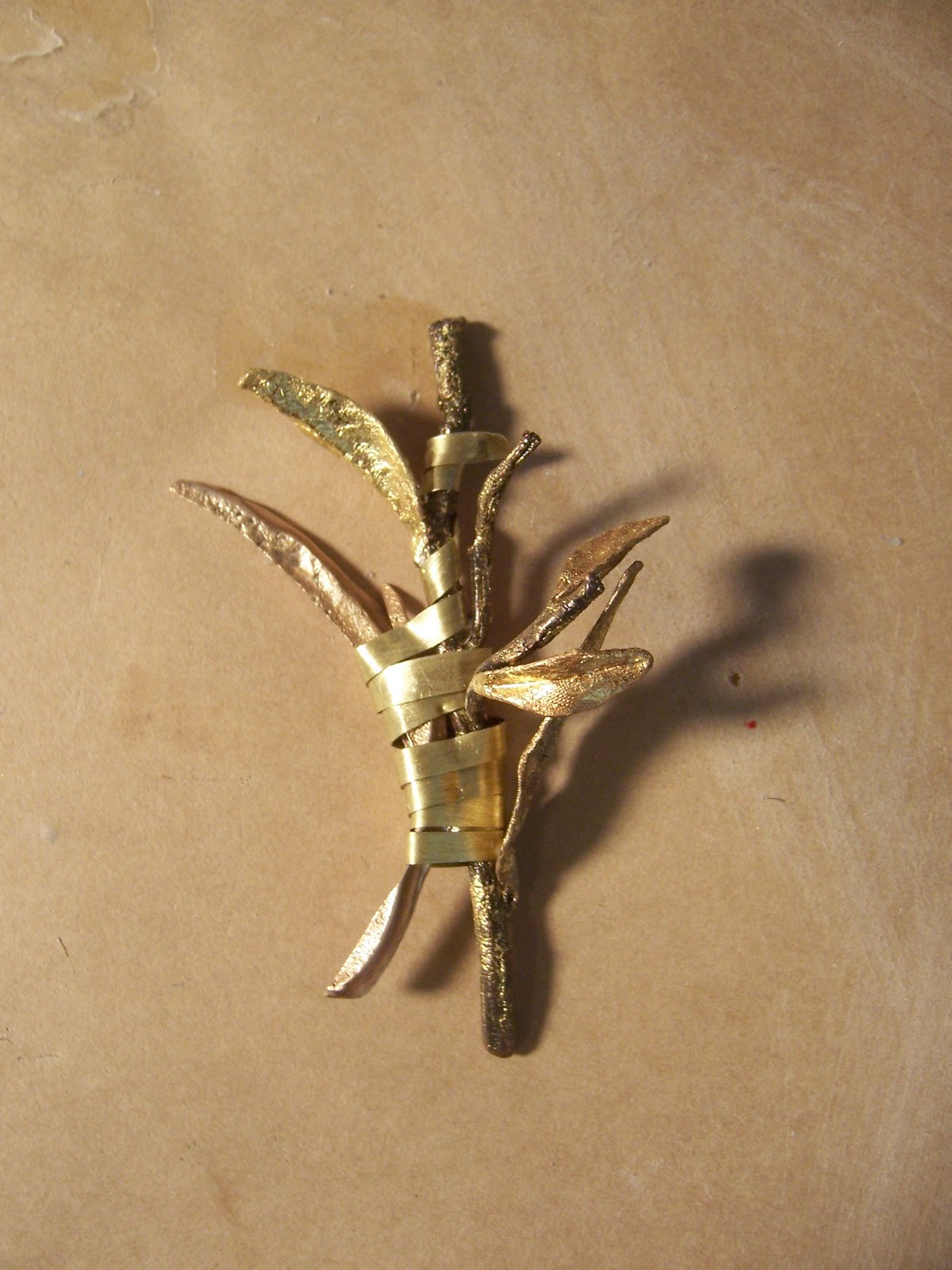
electroformed rock pile


Rock pile
raised form:
heat patina, ferric nitrate sprayed, pea green strain applied with brush and left to dry, red dye oxide bronze rub, bowling alley wax
Wood forms:
Diluted textile pigment, sprayed minwax dark wood stain, red textile paint, brown textile paint, bronze rub, bowling alley wax, gold leaf
Tuesday, January 25, 2011






Subscribe to:
Posts (Atom)